
YOUR NEIGHBOURHOOD MASSAGE STUDIO · MONTRÉAL
Lymphatic drainage works differently from every other massage your therapist does. The pressure is very light. The strokes follow a defined map through your lymphatic vessels toward your lymph nodes. Your body moves the fluid the rest of the way on its own after the session ends.
Most people who book lymphatic drainage in Montréal come with a specific problem. Post-surgical swelling. Legs and ankles that stay puffy after a full day’s rest. Spring sinus congestion that builds from April through June. Fibromyalgia fatigue. Or a clear recommendation from their surgeon after a procedure.
At Spa New You on Saint-Jacques in Saint-Henri, our massage therapists use the Vodder method. Sessions run seven days a week, 10:30 to 20:30. Insurance receipts may be available for sessions with eligible therapists. Please confirm receipt availability when booking. Reimbursement depends on your insurer and policy.
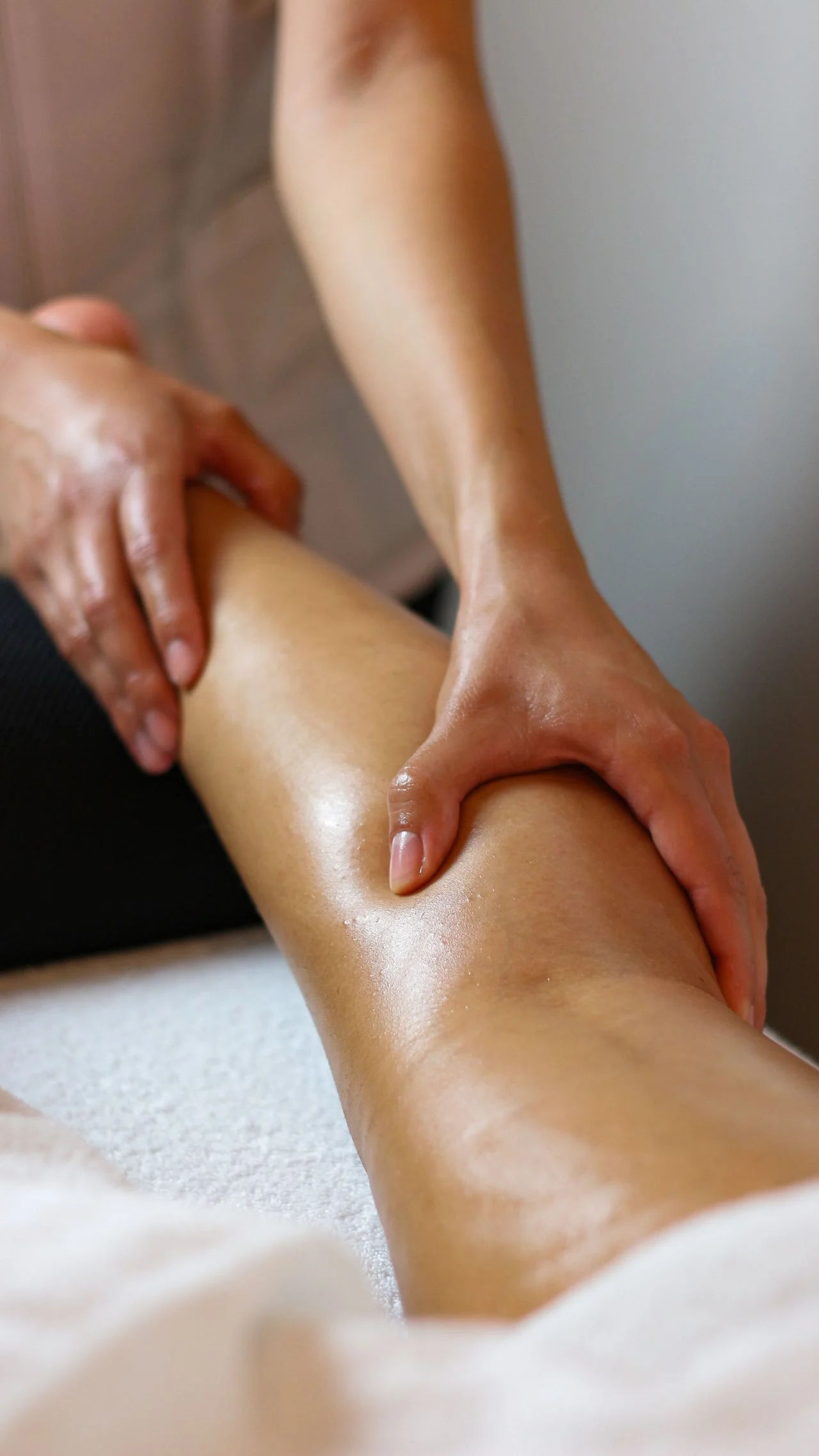
Your lymphatic system has no pump. It relies on muscle movement, breathing, and tissue pressure to keep fluid circulating. When those inputs drop — after surgery, during illness, or through a Montréal winter of reduced movement — fluid builds in your tissue and the system slows significantly.
Manual lymphatic drainage, or MLD, is the external input the system needs when movement alone is not enough. A trained therapist applies very light, rhythmic, directional pressure using Vodder-method sequences to open the lymphatic capillaries and drive fluid toward the lymph nodes where it can be filtered and cleared.
The pressure is much lighter than any other massage. Roughly the weight of a coin resting on your skin. That is not weak technique — it is the correct pressure for the lymphatic capillaries that sit just beneath the skin surface, well above the muscle layer.
After your session, the lymphatic system continues the process your therapist started. Drinking water and doing gentle walking after your appointment supports ongoing drainage. Many clients notice a measurable lightness within the first hour of finishing a session at the clinic.
Lymphatic drainage is not a relaxation massage. There is no deep pressure, no kneading, and no gliding strokes through muscle tissue. If you come expecting the warmth and weight of a Swedish session, this will feel completely different. The technique is precise, light, and methodical from start to finish.
It is also not a substitute for medical care in active lymphedema management. Clients with a lymphedema diagnosis are usually in a Complete Decongestive Therapy protocol that includes compression garments and exercise alongside MLD. Bring your treatment notes to the first appointment so your therapist can work within your existing protocol.

These are the five presentations we work with most often at Spa New You. If yours matches one of them, you are in the right place.
After liposuction, abdominoplasty, a mastectomy, breast augmentation, or orthopaedic joint replacement — any procedure that cuts through or near lymph nodes and vessels — fluid accumulates in surrounding tissue. For many clients in Montréal, this swelling lasts weeks longer than their surgeon expected it would.
Your surgeon’s post-op notes are the first thing your therapist reviews. If you have medical clearance and it has been at least seven to fourteen days since your procedure, we can start. The sessions are light enough that they do not compromise surgical healing when applied correctly and with clearance confirmed.

Lymphedema is a chronic condition in which the lymphatic system cannot keep up with the fluid load in a limb. The arm or leg swells, the skin feels tight and heavy, and the fluid does not clear with rest or elevation alone. It requires consistent management, not a one-time treatment.
Lymphatic drainage is the manual component of Complete Decongestive Therapy. Regular sessions — often once or twice a week in the active treatment phase — reduce the baseline swelling and support the compression garments in doing their job more effectively between appointments.

Fibromyalgia involves widespread pain, tenderness, fatigue, and what many clients describe as a deep heaviness in the tissue that never fully clears. Part of that congestion is lymphatic. The inflammatory load overburdens the lymphatic system and fluid sits in tissue longer than it should.
Lymphatic drainage reduces that fluid burden without triggering the pain response that firmer massage often causes in fibromyalgia clients. The very light pressure is an advantage here, not a compromise. It is often the only massage technique fibromyalgia clients can tolerate without a flare in the days that follow.

Montréal’s spring allergy season runs from April through June, with birch, grass, and ragweed pollen among the highest-burden periods on the island. That allergic load means the lymph nodes in your neck and head are working overtime. The cervical nodes that drain the face and sinuses can become sluggish under sustained pressure.
Gentle drainage of the cervical lymph nodes and the facial lymphatic vessels reduces sinus pressure, post-nasal drip, and the puffy, congested face that builds through allergy season. Many clients notice the difference within 24 hours of a session focused on the head and neck.

Whether it is a wedding, a corporate event at a downtown Montréal venue, or a significant occasion you have been preparing for, fluid retention in the face, jaw, and ankles is visible in photographs and felt in every piece of fitted clothing you put on in the morning.
A single session booked three to five days before your event gives the body enough time to process and drain the released fluid. The result is a more defined jaw and eye area, reduced ankle heaviness, and the general lightness that most clients who book this way want to keep as a regular appointment.
Lymphatic drainage follows a specific protocol every time. Here is exactly what happens at every appointment at Spa New You so you know what to expect before you arrive.
Before your session starts, your therapist does these things:
This intake is not a formality. Getting it right before the session starts is the whole point.
You lie on the treatment table, typically face-up to start. Light draping is repositioned as the sequence moves through different body areas. The first technique your therapist applies is always central — the neck, clavicular nodes, and axilla — to create drainage capacity before fluid is moved in from the periphery of the limbs.
The five core Vodder-method techniques — stationary circles, pump, rotary, scoop, and thumb circles — are applied in a specific order that follows the lymphatic anatomy of the body. Each technique addresses a different tissue layer and a different phase of the drainage process. None of it is improvised.
Sessions feel very gentle. Some clients fall asleep. Others notice gurgling or movement in the abdomen as lymph flow increases through the digestive region. Both responses are normal. If any area feels uncomfortable, tell your therapist and pressure is adjusted without interrupting the sequence.
Most clients feel lighter immediately after. Some develop a mild fatigue in the afternoon as the body processes the cleared fluid. Headaches are possible in the first session, particularly in clients who present with significant systemic congestion. Both resolve within a few hours.
The lymphatic system continues working after the hands-on stimulus from your session. Clients who follow the post-session advice — water, walking, no heat — often see continued improvement through day three or four before fluid begins to re-accumulate at a lower baseline than before the session.
Swelling is measurably reduced in most presentations. Post-surgical clients often notice that their compression garment fits more loosely than it did before the session. Fibromyalgia clients typically report reduced tissue heaviness and slightly improved energy, though this response takes a few sessions to become consistent.
A single session does not always produce obvious results, particularly in chronic presentations. Lymphatic drainage works cumulatively. Most clients with lymphedema or fibromyalgia need three to five sessions before meaningful change in baseline is measurable. If you see no change after five sessions, your therapist reassesses the approach and technique.
This depends entirely on why you are coming. There is no universal answer. Here are the three most common situations and a realistic session plan for each one.
Post-surgical clients typically need the most frequent sessions in the shortest window. The first two to four weeks after a cosmetic or orthopaedic procedure are when fluid accumulates fastest and when drainage does the most work. Three sessions in the first two weeks, dropping to once or twice a week in weeks three and four, is a common starting protocol.
For clients managing an ongoing condition, frequency depends on baseline severity. An active management phase of one to two sessions per week typically runs four to eight weeks to reduce swelling to a workable baseline. A maintenance phase of one session per month follows, adjusted upward during Montréal winters when movement drops and the lymphatic system slows with it.
Clients who come for sinus congestion during allergy season, or who feel sluggish and puffy through the low-movement winter months, typically respond well to two to three sessions over two weeks. After that, monthly maintenance keeps the system moving. Many clients pair their monthly session with the 60-minute Regular Cleaning facial at $85 for a combined lymphatic drainage and skin treatment in a single visit.
Your therapist gives you a specific recommendation at the first session after reviewing your intake and assessing how your tissue responds. You are never locked into a package or a minimum purchase.
Spa New You is at 3259 Saint-Jacques Street in Saint-Henri, centrally located for clients across the Sud-Ouest borough and the west end of the island. Here is how long it takes to get here from the neighbourhoods we most commonly serve.
By métro, take the orange or green line to Lionel-Groulx station — the only interchange point for both lines in the west end — then Bus 36 on Saint-Jacques westbound. The clinic is three stops from Lionel-Groulx, approximately an eight-minute ride. The walk from the stop to our door is under two minutes.
Street parking is available on Saint-Jacques and the surrounding streets in Saint-Henri throughout the day. Sunday parking on residential streets near the clinic has no time restrictions. Metered parking applies on weekdays. There is typically turnover on the block during business hours.
Spa New You is in the same neighbourhood as Marché Atwater, the Lachine Canal cycling and walking path, and Parc Marguerite-Bourgeoys. Clients from the Plateau-Mont-Royal (H2J, H2W), Mile-End (H2T), and Rosemont (H1X, H2G) regularly come across the island for the combination of service quality and transparent flat-rate pricing.
H4C (Saint-Henri), H4E (Côte-Saint-Paul), H4A (NDG west), H4B (NDG east), H4G (Verdun north), H4H (Verdun south), H8P (LaSalle north), H8R (LaSalle central), H3Y (Westmount south), H3Z (Westmount north), H3X (Côte-des-Neiges south), H3W (Côte-des-Neiges north), H3B (downtown west), H3G (downtown central), H3H (Shaughnessy Village), H2X (Chinatown / Milton-Parc), H2T (Mile-End south), H2J (Plateau-Mont-Royal), H2W (Plateau central), H1X (Rosemont)
Spa New You also offers a 60-minute Regular Cleaning facial at $85. The treatment combines deep cleansing, exfoliation, and improved blood circulation under the skin to reduce puffiness and support a healthy glow. Paired on the same visit as lymphatic drainage, the cervical and facial drainage from your MLD session directly complements what the facial does for the skin.
Insurance receipts may be available for sessions with eligible therapists. Please confirm receipt availability when booking. Reimbursement depends on your insurer and policy.
Spa New You gift cards are available in any dollar amount. A gift of lymphatic drainage is practical and specific — something many clients dealing with post-surgical recovery or chronic edema genuinely need but do not purchase for themselves.
FQM membership and insurance-receipt availability vary by therapist. If you require an insurance receipt, please confirm your therapist’s membership and receipt availability when booking. Reimbursement depends on your insurer and policy.
Our lymphatic drainage therapists:
When you call to book, ask which therapist has availability for lymphatic drainage. Not every therapist at the spa offers every service. The phone call takes 30 seconds and matches you to the right person for your specific presentation.
Note to editor: These are representative composite cases based on typical presentations. No individuals are identified.
A client from Verdun (H4H) came in three weeks after an abdominal liposuction procedure. Her surgeon had cleared her for massage at day fourteen. The swelling had not decreased as expected and her compression garment was still difficult to put on in the mornings. She had been reassured that it would resolve, but it had not moved in ten days.
Her therapist reviewed the intake form and surgical notes, then opened with stationary circles at the inguinal nodes and axilla before working through the abdominal drainage sequence. The session was 60 minutes. By the second appointment three days later, she reported the garment fit noticeably more loosely and the morning tightness had decreased enough to put it on without help.
After five sessions over two weeks, the presenting swelling was within normal recovery range for her procedure date. She continued on a once-per-week maintenance schedule for a further three weeks as her surgeon recommended. The factor that drove her result was the timing: starting at day fourteen rather than waiting for spontaneous resolution prevented the fluid from organising into harder, more resistant tissue.
This result is typical for post-cosmetic surgery clients who begin lymphatic drainage within the first four weeks. The earlier sessions begin — with surgical clearance confirmed — the more drainage can prevent fluid from becoming chronic. Waiting is rarely the right strategy when post-surgical swelling is significant and the surgeon has cleared manual therapy.
A client in NDG (H4B) had been managing fibromyalgia for several years. She had tried Swedish massage and deep tissue work but both left her in a significant flare for two days afterward. Her rheumatologist mentioned lymphatic drainage as a lower-pressure option that some fibromyalgia patients respond well to. She arrived sceptical but willing to try a few sessions.
The therapist used exclusively light-pressure Vodder-method techniques throughout the first session and avoided the trapezius and rhomboid region entirely because of her reported sensitivity there. Focus was on cervical drainage, axillary clearing, and the anterior trunk. She described it as the first massage she had received in two years that did not make her feel worse the following day.
After four sessions over a month, she reported measurably reduced leg heaviness in the mornings and a slight improvement in sleep quality. The fatigue response after exertion was not eliminated. But the baseline feeling of tissue congestion — the deep heaviness she described as her worst daily symptom — had decreased enough that she was consistently able to function through the afternoon.
Fibromyalgia does not respond to lymphatic drainage the same way for every client. Some see significant relief, others see modest improvement. What it consistently offers is a technique that does not risk triggering a flare, which makes it a viable option when pressure-based massage is contraindicated. Monthly maintenance has kept her baseline stable through two Montréal winters.
A client from Westmount (H3Y) booked a single lymphatic drainage session four days before her wedding. Her specific concern was facial puffiness around the eyes and jaw that had been building over several months of planning stress. She had never had lymphatic drainage before and wanted an honest answer about what was realistic from one session.
Her therapist focused the session on cervical lymph node drainage, facial lymphatic sequences, and the anterior neck vessels that drain the facial region. The session was 60 minutes. She was advised to drink water, avoid alcohol for 48 hours, and do light walking on each of the days between the session and the event rather than intense exercise.
She came back after the wedding to report that the jaw and eye puffiness had visibly reduced by day two. She attributed part of this to the session and part to better sleep in the days that followed. Her therapist noted that the combined effect — lymphatic clearance plus reduced cortisol response — was likely what made the result as clear as it was.
For single pre-event sessions, the realistic expectation is a moderate reduction in existing puffiness and a general lightness rather than a dramatic transformation. Clients who see the best pre-event results are those who book three to four days out, follow the post-session advice carefully, and arrive having already been managing their fluid retention through some form of regular movement.
Insurance receipts may be available for sessions with eligible therapists. Please confirm receipt availability when booking. Reimbursement depends on your insurer and policy. Please check annual limits, per-session limits and any referral requirements with your insurer before your appointment.
No. The pressure is very light — roughly the weight of a coin resting on your skin. If anything feels uncomfortable, you tell your therapist and the pressure is adjusted immediately. The technique works because of the direction and rhythm of the strokes, not the force applied. Clients who arrive expecting deep tissue pressure are reliably surprised by how different it feels.
If you have post-surgical swelling, diagnosed lymphedema, fibromyalgia with significant tissue heaviness, chronic sinus congestion, or general puffiness that does not resolve with rest, you are likely a candidate. The quickest way to confirm is a two-minute phone call before you book. Tell us what you are dealing with and we will tell you honestly whether MLD is likely to help your specific situation.
Yes. Active infection, congestive heart failure, deep vein thrombosis, acute kidney failure, and certain active oncology situations are absolute contraindications. Your therapist reviews your health intake at every visit. If a contraindication is present, the session does not proceed. This is not a checkbox exercise — applying lymphatic drainage over an active contraindication causes real harm, and we do not do it.
Yes. Many clients combine MLD with the 60-minute Regular Cleaning facial at $85. Clearing the cervical and facial lymph nodes through lymphatic drainage complements the deep cleansing, exfoliation, and improved blood circulation that the facial treatment provides. The two work well on the same visit. A soft, less congested skin surface responds better to facial treatment than one still carrying fluid.
For post-surgical swelling, many clients notice a difference within 24 to 48 hours of the first session. For chronic lymphedema and fibromyalgia, meaningful change at the baseline typically takes three to five sessions. Single pre-event sessions produce a moderate reduction in puffiness by day two or three. There is no uniform timeline because the presenting condition drives the response more than the session itself.
At minimum, 500 ml in the hour after your appointment. More is better. The lymphatic system needs adequate fluid volume to move efficiently, and the drainage your therapist stimulated continues after you leave the table. Clients who are poorly hydrated before a session consistently see a smaller immediate response than those who arrive having already been drinking normally through the day.
Manual lymphatic drainage (MLD) is a specific massage technique developed by Dr. Emil Vodder in the 1930s. It uses very light, rhythmic, directional pressure to stimulate the lymphatic vessels and nodes, increasing the frequency and strength of lymphatic contractions. The result is that fluid moves through the vessels toward the lymph nodes more efficiently than the body can manage on its own under sedentary or post-surgical conditions.
Regular massage targets muscle tissue with moderate to firm pressure. MLD targets the lymphatic capillaries just beneath the skin surface using pressure lighter than any standard massage modality. The techniques are completely different, the tissue layer being addressed is different, and the physiological goal is different. One session reduces muscle tension. The other moves interstitial fluid through a specific anatomical route toward the lymph nodes.
Sessions are available in 45, 60, 75, 90, and 120-minute durations. For post-surgical recovery, 60 minutes is the practical minimum for a meaningful treatment sequence. For general wellness and sinus drainage, 45 minutes is sufficient. For full-body lymphedema management or fibromyalgia presentations with widespread congestion, 90 minutes gives the therapist enough time to work through the complete sequence properly.
No referral is required at Spa New You. Call and book directly. If you have a medical condition, a lymphedema diagnosis, or recent surgery, bringing any relevant notes or surgical clearance to the first appointment is helpful and saves time at intake. Your therapist reviews everything before the session starts, not during it.
Wear comfortable, loose-fitting clothing. Unlike Swedish or deep tissue sessions that use oil on bare skin, some lymphatic drainage sequences — particularly for the face, neck, and head — are performed through light clothing. The therapist adjusts draping based on the area being treated. If you are unsure what to bring, ask when you call to book and we will tell you exactly.
Lymphatic drainage can be appropriate during pregnancy, particularly for managing lower limb edema that is common in the second and third trimesters. The technique requires modification for pregnant clients and should only be performed by a therapist with prenatal massage training. Tell us you are pregnant when you call so we can confirm the right therapist and approach for your stage of pregnancy.
This depends entirely on the procedure and your surgeon’s instructions. Many cosmetic surgeons recommend beginning MLD between 7 and 14 days post-procedure once incision sites are stable. Orthopaedic and reconstructive procedures require individual evaluation. Bring your post-op care instructions and your surgeon’s contact information to the first appointment so your therapist can confirm the approach is appropriate.
Yes. Cyclical water retention that accumulates in the legs, ankles, face, and abdomen in the days before menstruation is partly lymphatic in origin. A session in the three to five days before your expected peak retention can reduce the severity of the bloating and heaviness. This is one of the most common reasons clients in Montréal book a single monthly session as part of a regular wellness routine.
Call (514) 750-7070. We are open Monday through Sunday from 10:30 to 20:30. Describe your situation in two minutes on the phone and we will confirm whether lymphatic drainage is right for you, suggest a session length, and book a time that works. There is no online booking form — a phone call takes less time and gives us the information we need to match you to the right therapist immediately.
Street parking is available on Saint-Jacques and the surrounding streets throughout the day. On Sundays there are typically no time restrictions on residential streets near the clinic. On weekdays, standard metered parking applies on Saint-Jacques itself. If you come by transit, Bus 36 on Saint-Jacques runs directly from Lionel-Groulx métro station to our block and is the most reliable way to arrive from across the island.
Call (514) 750-7070. Tell us what you are dealing with — post-surgical swelling, lymphedema, fibromyalgia, sinus congestion, monthly water retention, or something else — and we will confirm whether lymphatic drainage is the right service for your situation before you book a session.
We are open seven days a week from 10:30 to 20:30. Same rate every day, no weekend surcharge. If you require an insurance receipt, please confirm therapist eligibility and receipt availability when booking. Sessions available in Saint-Henri, easily accessible from NDG, Verdun, LaSalle, Westmount, and every part of Montréal island.
Same-day appointments require a phone call.
Please call (514) 750-7070 to confirm availability.
Massage Therapy in Saint-Henri
Ask About Insurance Receipts
Serving Saint-Henri, NDG, Verdun, LaSalle, Westmount, Côte-des-Neiges, Plateau-Mont-Royal, Rosemont, and the full Montréal island.
Give your body a little extra care this year. Call or book your visit to claim your free hour.